When it comes to upper-body conditioning—especially for individuals in wheelchairs or those undergoing rehabilitation —the type of movement matters just as much as the effort. Traditional arm crank ergometers, long used for cardio and strength training, rely on a circular, forward-only motion that primarily targets the anterior (front) shoulder and chest muscles. While effective for some cardiovascular outcomes, this repetitive motion can lead to muscular imbalances and overuse injuries, particularly in the shoulders.
VitaGlide® was designed to solve that problem. Unlike traditional upper body ergometers that rely on circular motion, VitaGlide® uses a reciprocating push–pull movement along a horizontal plane—similar to a skiing or rowing motion. This approach engages both anterior and posterior muscle groups, promoting more balanced development of the chest, shoulders, back, and arms. As wheelchair-accessible cardio equipment and an intuitive seated cardio machine, it also more closely mirrors functional daily activities such as wheelchair propulsion, transferring, and reaching.
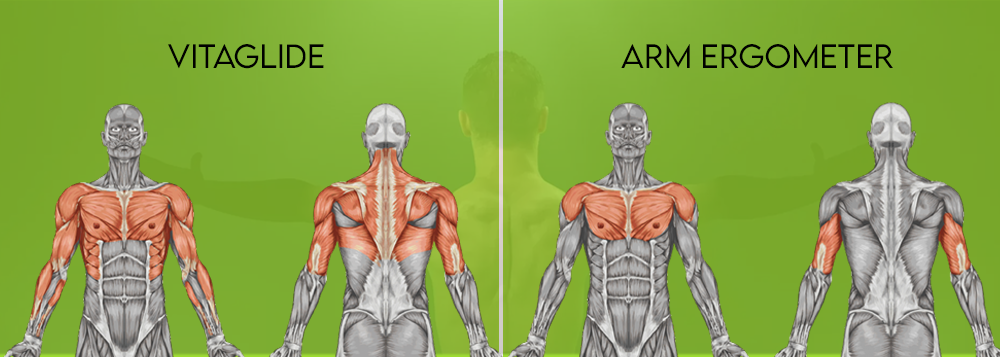
A side-by-side comparison of muscle activation (see image) clearly highlights the difference: VitaGlide® activates the entire upper torso, including deltoids, pectorals, biceps, triceps, lats, traps, and core stabilizers—while traditional upper body ergometers tend to focus more narrowly on the chest and shoulders, with limited engagement of the back and core. This broader muscle recruitment not only creates a more effective workout but also supports injury prevention and the development of functional, real-world strength.